The Cromlech of La Praz (Vaud, Switzerland)
What is a cromlech?
Geometry, cycles, and a place of observation
The term cromlech comes from the Brittonic languages, primarily Welsh: crom (“curved,” “bent,” “rounded”) and llech(“flat stone,” “slab,” “rock”).
It literally refers to a curved stone or, by extension, to a set of stones arranged in a circular or sub-circular form. This etymology immediately emphasizes not the isolated stone, but an intentional spatial organization—a constructed form inscribed within the landscape
In the approach developed by Alexander Thom (1894–1985), an engineer and professor at the University of Oxford, and later expanded by Howard Crowhurst, the cromlech is not understood as a mere symbolic or territorial marker. It is considered an operative geometric structure, connected to the observation of celestial cycles, particularly solar and lunar ones
(A. Thom, Megalithic Sites in Britain, Oxford University Press, 1967).
Based on remarkably precise field surveys, Thom demonstrated that many stone circles follow constant and reproducible geometric ratios: circles constructed from standardized radii, oval or “flattened” forms, and internal or peripheral alignments indicating specific directions in the landscape
(A. Thom & A. Burl, Megalithic Rings, BAR, 1980).
These observations led him to propose the existence of an operative geometry based on measurement, angles, and repetition—predating formalized Greek geometry. Howard Crowhurst explicitly continues this line of thought, extending the analysis to a geometry of the quadrivium—arithmetic, geometry, harmony, and astronomy—applied directly to the megalithic landscape
(H. Crowhurst, Mégalithes, principes de la première architecture monumentale du monde, 2018).
Within this framework, the cromlech can be understood as an astronomical observation device—or more precisely, as a spatial reference point enabling the tracking of the cyclical movements of the Sun and the Moon. Thom showed that many stone circles align with sunrise and sunset at the solstices, as well as with the extreme positions of the Moon during its 18.6-year declination cycle
(A. Thom, Megalithic Lunar Observatories, 1971).
Crowhurst extends this interpretation by emphasizing that the latitude of a site conditions the geometric validity of such constructions: a cromlech cannot simply be transposed anywhere. It is inseparable from the horizon, the topography, and the apparent trajectory of celestial bodies from a given observation point.
In this perspective, the cromlech functions as an architecture of time, making visible cosmic rhythms that are otherwise imperceptible at the scale of immediate human experience.
The Cromlech of La Praz — Observation point and territorial geometry
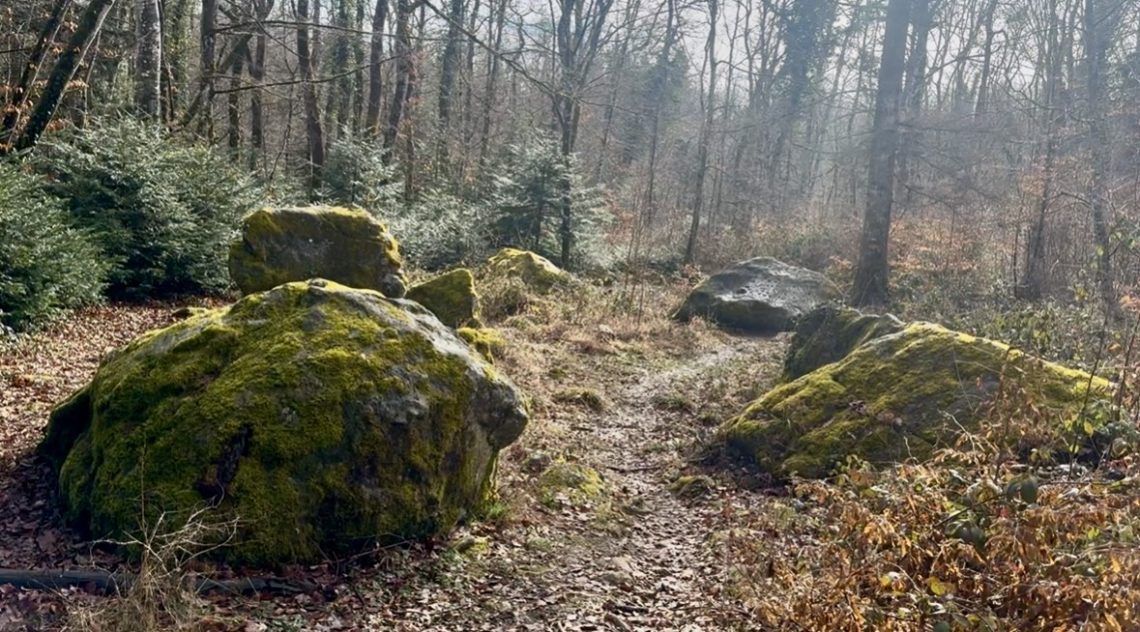
In the heart of the Vaud Jura, in a forest clearing between Mont-la-Ville and La Praz, lies one of the few documented cromlechs in French-speaking Switzerland: the Cromlech of La Praz. Discreet and devoid of ostentatious monumentality, it stands out primarily for the coherence of its spatial arrangement.
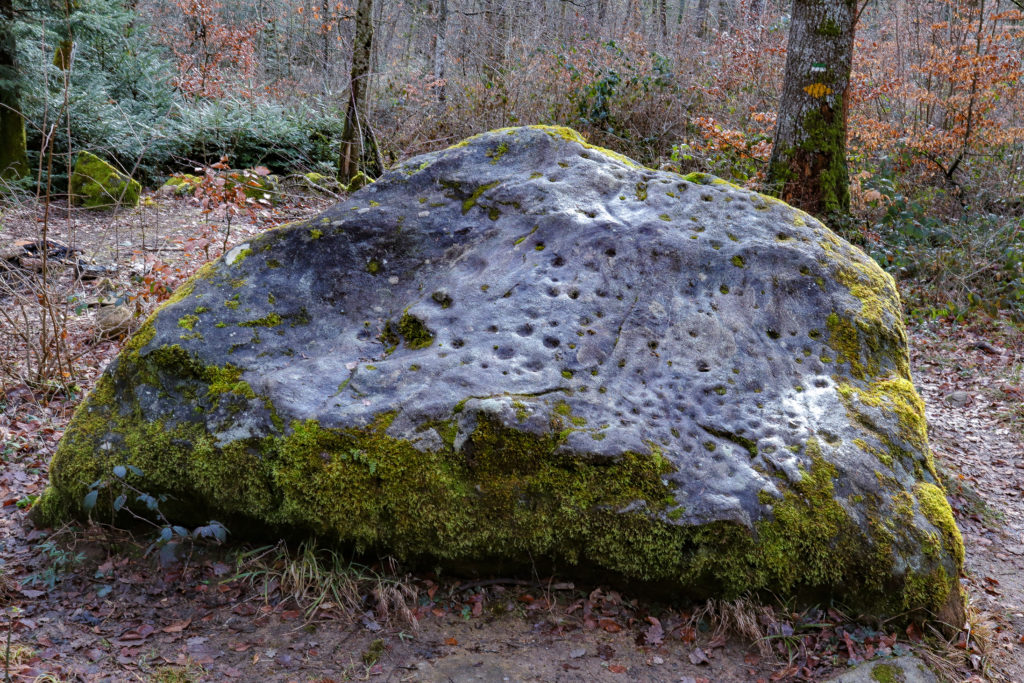
The structure is generally described as sub-circular or polygonal (often likened to a pentagon), about eight meters in diameter, composed of eight blocks. Two of these bear cup marks, including a major stone located to the south, covered with numerous cavities and channels, clearly indicating intentional human intervention
(Source: Archaeological Inventory of the Canton of Vaud).
From the perspective of Thom and Crowhurst, this formal simplicity is not a deficiency but a clue: what matters is not mass, but geometric function. To date, I do not know whether published astronomical azimuth surveys exist specifically for La Praz. However, private analyses conducted by Howard Crowhurst, based on the site’s coordinates and environment, provide remarkable insights.
During direct exchanges (personal communication, May 2018), Crowhurst showed that the Cromlech of La Praz appears to occupy a central observation point within a coherent territorial system.
Between the cromlech and the Pierre des Gottettes—discussed in a future article—the measured distance is approximately 4,300 meters. This corresponds very precisely to a 3-4-5 triangle ratio, with a base unit of 860 meters, a type of geometry characteristic of megalithic constructions studied by Thom and Crowhurst.
The difference in altitude—around 800 meters for La Praz and 721 meters for the Pierre des Gottettes—confirms a clear line of sight oriented toward the summer solstice sunrise. The Pierre des Gottettes lies at the final high point along this line, with the southern edge of Lake Neuchâtel in the background.
This observation can be verified in the field and reproduced using tools such as Google Earth, confirming the geometric coherence of the system.
Crowhurst also notes that the Mormont mound lies exactly east of the cromlech, at a distance of about 6,510 meters, indicating with great precision the direction of sunrise at the equinox. The summit of the Mormont extends this axis, offering—according to his words—an equinoctial sunrise “rolling along the hillside,” observable from La Praz.
These data suggest that the Cromlech of La Praz is not an isolated monument, but the nodal point of an observation system tracking the movement of sunrise along the Lake Neuchâtel valley throughout the year. The orientation of this valley—very close to the exact angle of a 3-4-5 triangle—would make it a natural sacred site whose geometry predates any human intervention.
Morphological correspondence appears to evoke Mont Blanc — a sensory reading of the landscape
During a recent visit to the site, an observation became strikingly evident: the main cup-marked stone of the Cromlech of La Praz bears a strong resemblance to the north face of Mont Blanc, with which it is already in directional and symbolic relation.
This perception is not a fleeting visual analogy, but the result of prolonged engagement with megalithic sites and a sensitive reading of landscape forms. The mass of the stone, its relief, its structural lines, and its way of occupying space clearly evoke the north face of Mont Blanc: compact, abrupt, closed, and womb-like.
The large summit cup mark, approximately 15 cm in diameter—still used today by some visitors as a “recharging” point—reinforces this impression of concentration, depth, and interiority, characteristics associated with this face of the mountain.
Even more striking, this morphological correspondence is not limited to La Praz. The Pierre des Gottettes, located about five kilometers away and already identified as a key point in the territorial system, appears to evoke the south face of Mont Blanc, with which it is also in relation.
This south face, more open, expansive, and luminous, contrasts deeply with the north face, while remaining inseparably linked to it.
Thus, two nodal stones of the territory seem to reflect a clear polarity:
- at La Praz, a cup-marked stone associated with the north face of Mont Blanc, embodying concentration, grounding, and depth;
- at the Gottettes, a stone associated with the south face, embodying openness, diffusion, and connection.
This north–south correspondence cannot be understood as mere coincidence. It fits within a lived landscape logic, where the mountain is not just a distant landmark but a structuring presence, echoed and embodied by local stones.
This interpretation is based on direct experience of the site and attention to form, volume, orientation, and their bodily resonance. It belongs to a form of sensitive knowledge that seeks not to convince through demonstration, but through perceived evidence.
Within this framework, Mont Blanc emerges not only as a visual and geographical axis, but as a structuring pole of the regional sacred system, of which La Praz and the Gottettes would be complementary expressions.
A place of passage
Understood in this way, the Cromlech of La Praz is neither a temple in the classical sense nor a simple archaeological relic. It appears as a place of passage—a point of connection where intersect:
- measure and number,
- sky and earth,
- cyclical time and lived space.
In the lineage of Alexander Thom, Howard Crowhurst, and Stéphane Cardinaux, La Praz can be read as a relational device, designed less to impose meaning than to enable an experience: that of an ordered world in which stone, landscape, and celestial bodies participate in the same living geometry.
Sun, Moon, and the temporality of the site
In Thom’s model, some cromlechs function as lunar and solar observatories, marking:
- sunrise and sunset at the solstices,
- the extreme positions of the Moon in its 18.6-year declination cycle
(A. Thom, Megalithic Lunar Observatories, 1971).
Crowhurst extends this by showing that latitude determines the validity of certain geometric constructions related to celestial movements. La Praz, located along the Jura ridge, lies in a zone where topography, horizon, and celestial paths can be meaningfully correlated.
The cromlech thus becomes an architecture of time—not a fixed calendar, but a device through which cosmic rhythms become perceptible via movement of the body, gaze, and shadow.
Sacred geometry and the quality of place
The work of Stéphane Cardinaux (Sacred Geometries – Volume 1, 2008) provides a complementary perspective focused on the intrinsic quality of place. He shows that many ancient sites combine:
- visible, measurable geometry,
- and telluric receptivity linked to ground structures, underground flows, and resonance zones.
In this context, the Cromlech of La Praz can be understood as an anchoring point, where constructed geometry overlaps with the geometry of the terrain. The cup-marked stone acts as a mediating surface, concentrating and redistributing attention, gesture, and possibly water or light.
Function of the site: an approach based on natural interaction sciences
The absence of conclusions from material archaeology does not imply absence of function. The Cromlech of La Praz can be approached as an interactive structure embedded in a structured natural environment, based on well-documented physical phenomena: fields, flows, resonances, inductions.
In the age of digital technologies and invisible communications, the existence of imperceptible phenomena is no longer speculative. Wind, electromagnetic waves, magnetic fields, and telluric currents act invisibly, measurable only through their effects.
From this perspective, the cromlech is not a passive relic but an organized structure exploiting natural properties of the site.
Contributions of Stéphane Cardinaux: a geobiological reading of the site
The work of Stéphane Cardinaux constitutes one of the most detailed bodies of research devoted to the geobiological and telluric study of the La Praz – Mont-la-Ville region. His research is based on systematic field surveys, measurements, and spatial modeling of observed natural interactions.
He notably describes circular structures that he refers to as “giant cupules,” characterized by precise geometry, a recurring position on telluric nodes, and dimensional coherence. He proposes that these structures may have a function related to the regulation of atmospheric humidity, a hypothesis supported by modern experiments conducted in other regions of Europe.
In the La Praz area, Cardinaux identifies an exceptional concentration of blocks positioned on strategic geophysical points, which, in his view, is incompatible with a purely random distribution. He proposes a global reading of the landscape based on lines of force, intersecting flows, and an overall geometric organization.
Regarding the cromlech itself, he notes that the term is debatable from a strictly formal standpoint, as the structure more closely resembles a structured quadrilateral than a perfect circle. Nevertheless, he describes a coherent system centered on a major cup-marked stone, associated with a precise orientation and a marked geophysical interaction point.
The energetic system is thought to be centered on this major cup-marked stone, which features:
- a large summit cupule approximately 15 cm in diameter,
- around sixty secondary cupules connected by vertical channels,
- an orientation of its main face toward Mont Blanc,
- an intersection of level-3 Curry lines corresponding to the center of a vortex and a vertical energy channel.
Use and activation of the site
In Cardinaux’s interpretation, certain blocks are believed to fulfill specific functions:
- a so-called “switch” stone used to activate the vortex and associated “energy tubes,”
- a flat platform located on a negative vertical channel, designed for sitting,
- an alternating cycle of energetic charge and discharge allowing a temporary increase in vital energy.
He primarily suggests a therapeutic function, while emphasizing that the exact practices and rituals associated with the site remain unknown.


Contemporary use and continuity of practice
Beyond archaeological data and interpretative models, one observable fact should be noted: the site of La Praz is still in use today.
Through direct experience and repeated observation, it appears that some individuals visit the site with a clear intention of personal regulation—cleansing, recentering, energy recovery—as well as to leave offerings.
These gestures take simple forms: natural objects, moved stones, plant materials, sometimes water or symbolic food. They do not belong to any organized folklore or codified ritual, but rather to a spontaneous and recurring use.
This observation does not imply any doctrinal interpretation. It simply indicates that the site continues to be perceived as functional, in the sense that it produces an effect sought by those who visit it.
In the study of ancient sites, the persistence of use—even when transformed or silent—is an indicator in its own right, too often dismissed because it does not fit within conventional analytical frameworks.
Archaeology itself acknowledges that certain places endure through time while retaining a specific attractiveness, regardless of the cultures that engage with them. The Cromlech of La Praz appears to belong to this category of sites with continuity of use, where function is not fixed in the past but reactivated differently across periods.
Conclusion
The Cromlech of La Praz is not a static relic: it is a living place where sky, earth, and human perception meet.
It invites one to walk slowly, to feel the terrain, to perceive invisible flows and the silent rhythm of celestial bodies.
Each stone, each cavity, each orientation becomes the mediator of a subtle experience. The site reveals itself not through force, but through attention and intuition: it teaches respect for the cycles of the world, for measure and for harmony.
Here, the human gesture meets the geometry of the world, and perception becomes initiatory; the soul, even fleetingly, attunes itself to cosmic cycles and the murmurs of the earth.
La Praz remains a territory of the heart and the gaze, where past and present enter into dialogue, and where the sacred dimension of space becomes tangible.
The Quadrivium Applied to Megaliths
In the approach developed by Alexander Thom and later expanded by Howard Crowhurst, megalithic monuments—and particularly cromlechs—belong to a structured body of knowledge that can be related to the quadrivium, that is, the four traditional disciplines of the science of number and the cosmos: arithmetic, geometry, music (harmony), and astronomy.
Arithmetic — measurement and repetition
Alexander Thom demonstrated the existence of recurring units of measurement in the construction of stone circles, notably what he called the Megalithic Yard (approximately 0.83 meters). Without assuming a rigid universal standardization, he showed that the builders had mastered the quantification of space, the repetition of lengths, and the coherence of proportions
(Source: Alexander Thom, Megalithic Sites in Britain, Oxford University Press, 1967).Geometry — constructed form
The cromlechs studied by Thom display circular, elliptical, or “flattened” forms, built upon simple yet rigorous geometric principles. Howard Crowhurst builds upon these observations and extends them to constructions based on Pythagorean triangles (3-4-5), rectangles, and orthogonal axes, used to inscribe monuments within the landscape according to precise directions
(Source: Howard Crowhurst, Mégalithes, principes de la première architecture monumentale du monde, 2018).Music — harmony of ratios
In the quadrivium tradition, music does not refer to sound, but to the harmony of numerical relationships. Crowhurst explicitly applies this concept to megaliths: the ratios of distances, angles, and proportions observed at certain sites reflect a search for harmonic balance, comparable to consonant relationships in music
(Source: Howard Crowhurst, public lectures, 2015–2022).Astronomy — celestial cycles
The astronomical dimension lies at the core of Thom’s work. He demonstrated that many cromlechs and stone circles are aligned with:
- sunrise and sunset at the solstices,
- the extreme positions of the Moon linked to its 18.6-year declination cycle
(Source: Alexander Thom, Megalithic Lunar Observatories, Journal of the Royal Statistical Society, 1971).Crowhurst extends this interpretation by showing that these celestial phenomena are integrated into the overall geometry of the site, dependent on latitude, transforming the cromlech into an observational instrument embedded in the landscape.
Synthesis
From this perspective, the cromlech is neither a simple symbol nor an isolated monument, but a learned architecture in which:
- number structures space,
- geometry orders form,
- harmony connects proportions,
- and astronomy situates the monument within cosmic time.
The quadrivium, therefore, is not a later projection, but a coherent operative framework for understanding the internal logic of certain megalithic constructions, as analyzed by Thom and Crowhurst.

Kvervandi
Kvervandi est un projet de création artistique mêlant exploration vocale, art visuel et musique inspirée par la nature et les mythes.

Vous pourriez aussi aimer

MEGALITHS, FORGOTTEN WORLD
MEGALITHES – UN MONDE OUBLIÉ